
Fitgenetix | Sleep
For most of modern history, sleep was treated as downtime. Your body ran out of energy, so it shut down for a few hours, and then you got back to it. That was the working theory for decades, and it shaped how we talked about sleep, how doctors thought about sleep, and how seriously anyone took it when sleep went wrong.
That theory is now obsolete.
In the last ten years, and especially in the last three to five, the science of sleep has been completely rewritten. Sleep is not passive. It is not the absence of being awake. It is an active biological state where some of the most critical processes in your body run. Processes that do not run any other time.
Your Body’s Night Shift
While you sleep, your body is running maintenance. Not optional maintenance. Scheduled, non-negotiable maintenance.
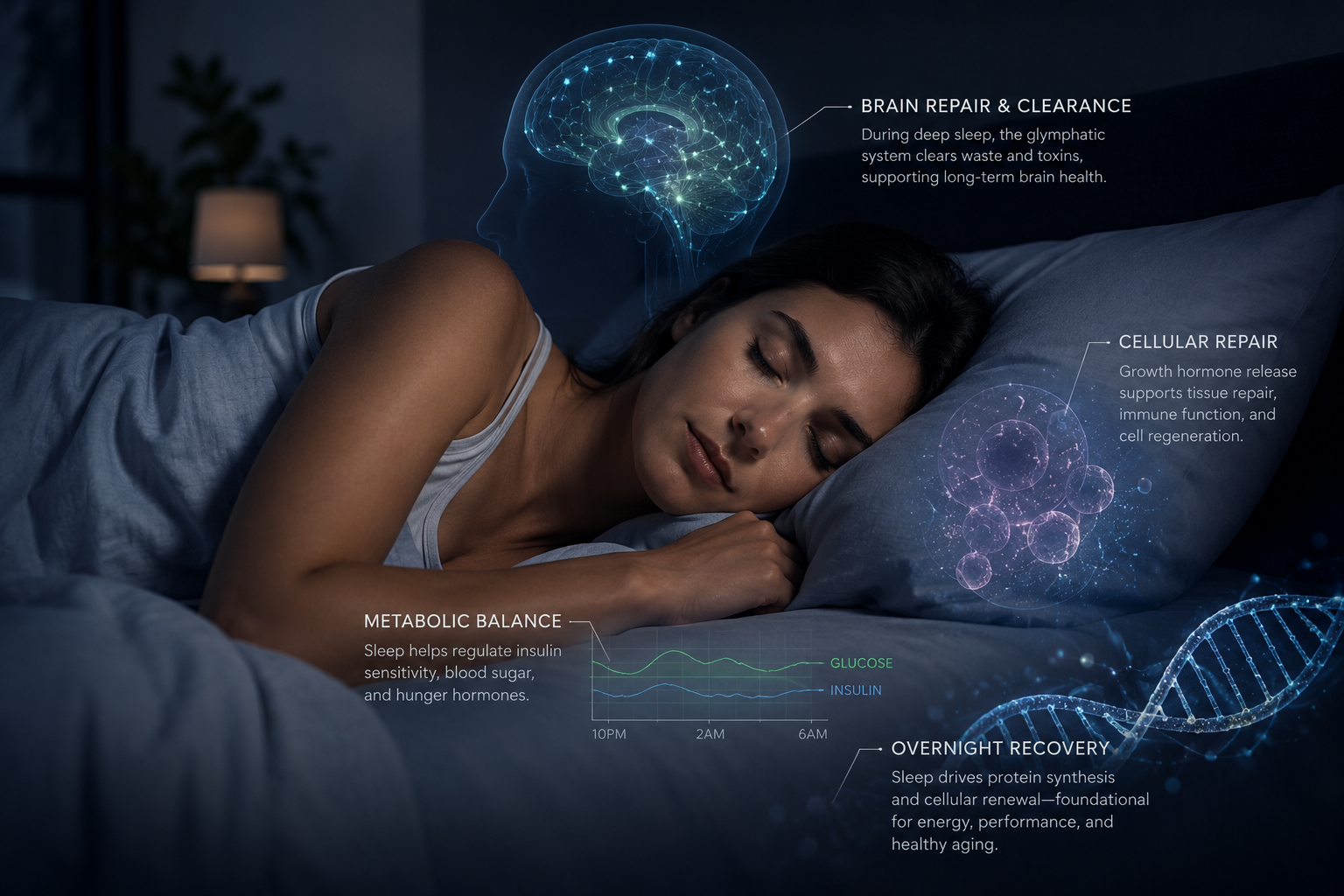
Your brain has its own waste removal system, called the glymphatic system, that activates primarily during deep sleep. It flushes out toxic proteins that build up during the day, including a type called amyloid-beta that is directly linked to Alzheimer’s disease. Think of it as your brain’s cleaning crew. They only come in when the office is closed.
At the same time, your muscles and tissues are repairing themselves with the help of growth hormone, which your body releases in its highest concentrations during sleep. Your immune system is restocking and recalibrating, which is why you get sick more easily when you are not sleeping well. Your brain is sorting through the day’s experiences, strengthening the memories and skills that matter and clearing out the noise that doesn’t.
And one of the most important jobs happening overnight is metabolic. Your body recalibrates how it processes blood sugar while you sleep. This is not a minor adjustment. Research has shown that even a single night of poor sleep can measurably change how your body handles the food you eat the next day. Your cells become less responsive to insulin, your appetite hormones shift, and your cravings change. One night.
None of this is bonus recovery for overachievers. It is baselining biological function. When sleep is cut short or disrupted, these processes either run incomplete or do not run at all. And the effects are cumulative.
The Clinical World Caught Up
For a long time, sleep science operated at the edges of mainstream medicine. Researchers knew sleep mattered, but the broader clinical world treated it as a lifestyle factor, something to mention alongside “eat well and exercise” at the end of an appointment.
That changed in 2022 when the American Heart Association added sleep duration to its Life’s Essential 8, the official framework for measuring cardiovascular health. Sleep now sits alongside blood pressure, cholesterol, blood sugar, physical activity, diet, weight, and smoking as a core metric. Not a recommendation. A metric tracked and scored the same way doctors track your blood pressure.
That decision was not symbolic. It was backed by decades of accumulating evidence showing that poor sleep independently increases the risk of heart disease, stroke, and metabolic dysfunction. The AHA concluded that you cannot fully assess someone’s cardiovascular health without knowing how they sleep.
The research community is moving with the same urgency. SLEEP 2025, the largest annual gathering of sleep scientists and clinicians, drew over 6,000 attendees, a record, and the 2026 meeting in Baltimore continued that momentum. The American Academy of Sleep Medicine has formally positioned sleep as medicine, not a wellness add-on. The volume and quality of published research connecting sleep to chronic disease has accelerated dramatically.
This is not a wellness trend. This is clinical consensus.
The Connection Most People Miss
One of the most important findings in recent sleep research is the relationship between sleep and metabolic health, and the fact that it runs in both directions.
Poor sleep disrupts how your body handles blood sugar. That part is fairly well known at this point. But the reverse is equally true and far less discussed: blood sugar instability disrupts your sleep.
A published study of over 1,000 Japanese working adults found that people experiencing maintenance insomnia, waking up during the night, for two or more weeks had nearly seven times the odds of having elevated HbA1c, a key marker doctors use to track average blood sugar over the previous two to three months. People with early morning awakening had nearly four times the odds. These are not small associations.
What this means in practical terms is that someone waking at 3 AM every night may not have a “sleep problem” in the way they think. They may have a metabolic issue that is expressing itself through sleep disruption. The food they ate at dinner, the timing of their last meal, the composition of that meal, all of these can trigger a blood sugar drop in the middle of the night that releases cortisol and wakes them up. Fix the sleep hygiene all you want. Until you address what is happening metabolically, the pattern continues.
This bidirectional loop, where poor sleep worsens metabolic health and poor metabolic health worsens sleep, is one of the most clinically significant patterns in modern health research. And most people caught in it have no idea which direction is driving their problem.
The Scale of the Problem
The individual stakes are high. The population numbers are staggering.
Six out of ten American adults do not get enough sleep. Nearly half have trouble staying asleep three or more nights per week. Between 50 and 70 million Americans are living with an active sleep disorder. And according to a 2026 national survey of over 50,000 adults, the average American only feels well-rested three days per week.
This is not a discipline problem. People are not failing at sleep because they are lazy or careless. They are failing because the gap between what we now know about sleep biology and how most people still approach sleep is enormous. The science has leaped forward. The tools and guidance available to most people have not kept up.
The standard advice, keep the room cool, put the phone away, no caffeine after 2 PM, is not wrong. But it is generic. It treats every sleep problem as the same problem, and it skips the most important question entirely: what is actually causing your disruption?
What Comes Next
The science is clear on what sleep does and why it matters. Your body depends on sleep the way it depends on food and water. Not as a luxury. As a requirement for basic biological function.
The harder question is more personal. If your sleep is disrupted, what is actually driving the disruption? That is a different question than “how do I sleep better,” and it requires a different kind of answer. Because not all sleep problems are the same. Similar symptoms can come from completely different causes, biological, metabolic, behavioral, environmental, and the one driving yours determines what will actually fix it.
That is what we will get into in our next post.
____________________________________
Fitgenetix is a personalized health intelligence platform. We help individuals improve sleep, metabolic health, and healthy aging through programs built around their biology, including genomics, biomarkers, and health assessments, with guidance that adapts as their health picture evolves.